
Sampling risk
A small reviewed subset can miss repeatable process failures and channel-specific drift.
For Operations & Quality leaders
Direct answer
Define the eligible population, preserve audit evidence, reconcile missed work, and connect recurring findings to coaching and leadership decisions.
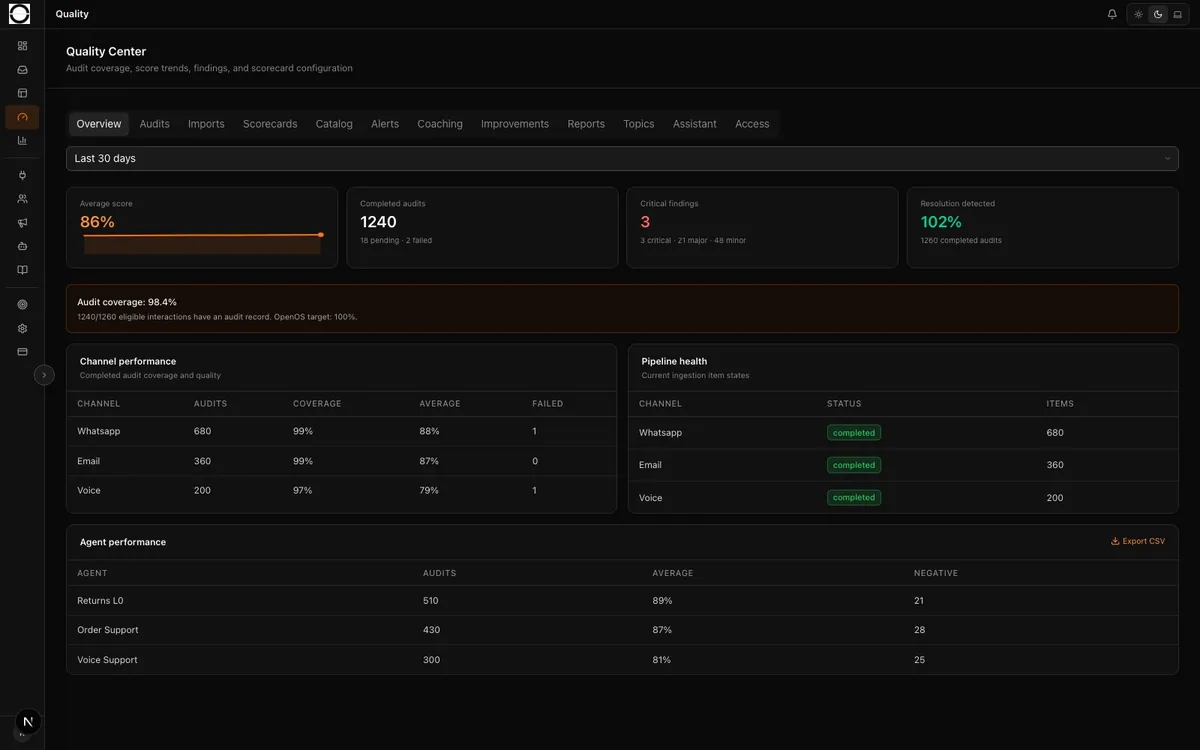 01 Coverage and score 02 Pipeline health
 Quality operations
The operating model must make eligibility, evidence, scorecard version, findings, and review context visible together.
A small reviewed subset can miss repeatable process failures and channel-specific drift.
Automated scoring requires version ownership, evidence review, and human operating controls.
Findings create value only when coaching and process changes can be followed through.
Mechanism
Define sources, eligibility, scorecard, criteria, and the denominator.
Audit eligible work and preserve criterion-level rationale and evidence.
Inspect findings, missed audits, calibration context, and channel patterns.
Route coaching and material process drift to the responsible operating role.
Operational control
OpenOS expands evidence and coverage; it does not remove policy ownership or professional judgment.
Quality leaders define what good support means and when a scorecard version changes.
Teams decide which sources and interaction states enter the audit population.
Evidence and rationale support review, disagreement handling, and model/process adjustment.
Coaching and process owners decide what change is required and how success will be measured.
Operating review
What percentage of the configured eligible population completed an audit?
Which criteria, intents, channels, or teams show repeated material failures?
Which coaching or process work has a named assignee and due date?
Did the selected quality or repeat-contact measure change after intervention?
Measures
Completed audits divided by configured eligible interactions.
Repeated material findings by criterion, intent, channel, queue, or team.
Owned coaching work completed within its defined operating window.
Direct answers
No. It changes where human effort is used: scorecard ownership, calibration, evidence review, exceptions, coaching, and process decisions remain essential.
Supported controlled imports and ingestion contracts can bring selected chat, email, and audio data into the Quality workflow.
Tailored walkthrough
A tailored walkthrough for Support/CX, operations, and technology leaders—using your channels, responsibilities, and success measures.
Prefer email? sales@openost.com