
Containment without safety
Resolution rate is incomplete without eligibility, fallback, and execution evidence.
For Support & CX leaders
Direct answer
See containment, escalation, quality, and ownership as one operating model—without replacing the channels, providers, or teams already serving customers.
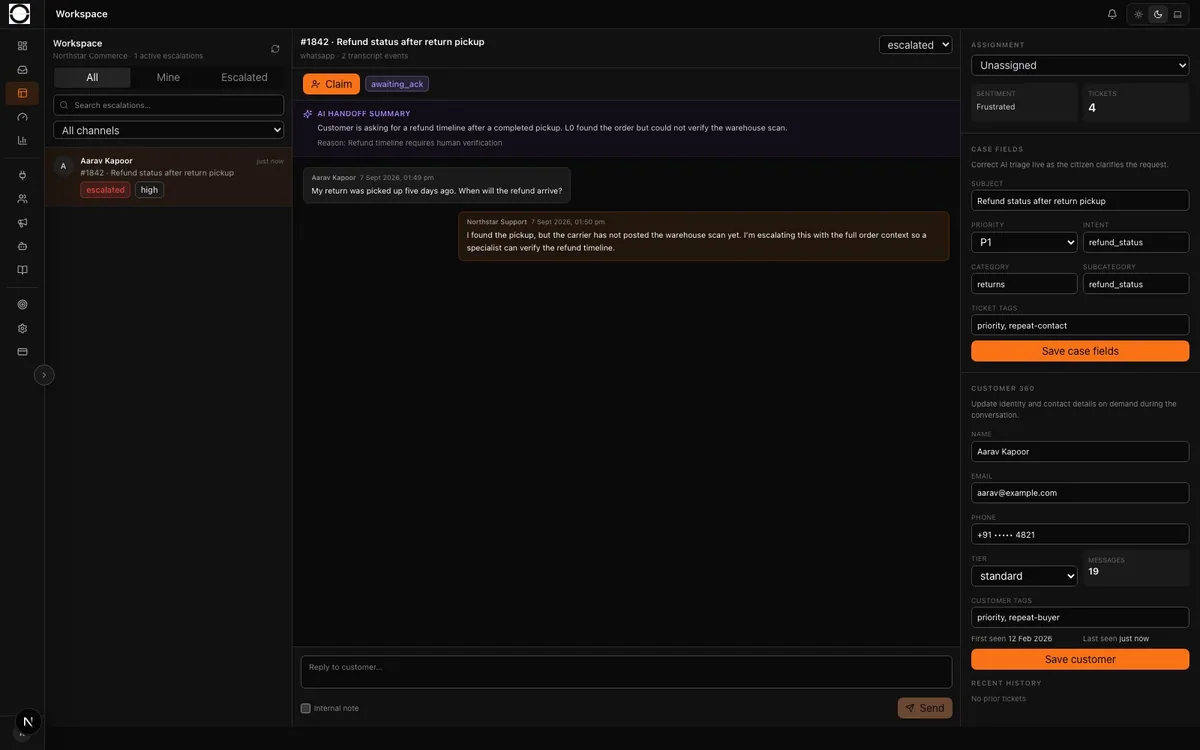 01 Contextual handoff
 Your operating model
OpenOS gives support leadership a shared evidence model across first contact, exceptions, quality, and repeated operational patterns.
Resolution rate is incomplete without eligibility, fallback, and execution evidence.
Every lost transcript or handoff reason adds handling time and customer effort.
A monthly score does not show what is drifting today or who should address the pattern.
Mechanism
Contain configured eligible requests through published L0 workflows.
Move exceptions to people with the complete conversation and customer state.
Evaluate configured eligible closes against versioned quality criteria.
Frame material support drift for leadership and convert selected action into managed work.
Operational control
Different roles use the same evidence at different levels of the support operation.
Claim exceptions, understand the customer state, resolve, and record the outcome.
See queue pressure, SLA risk, repeated intents, and quality findings.
Operate the eligible audit population, findings, and coaching loop.
Start from material decisions, evidence, ownership, and outcome movement.
First deployment shape
Choose one support intent, channel, current escalation path, and source of truth.
Define eligible automation, required context, quality criteria, and provider responsibilities.
Measure the baseline for containment, handoff completeness, quality, and unowned work.
Run the loop and review the same measures after the agreed intervention window.
Measures
Safe resolutions within the configured L0 scope.
Escalations carrying the required context and evidence.
Completed audits across the configured eligible population.
Direct answers
Yes. OpenOS can provide shared evidence, controls, and ownership across internal or outsourced support responsibilities without claiming to replace either operating team.
Choose one high-volume workflow with visible leakage, an existing provider path, and measures your team can define and review.
Tailored walkthrough
A tailored walkthrough for Support/CX, operations, and technology leaders—using your channels, responsibilities, and success measures.
Prefer email? sales@openost.com