
Support/CX lens
Containment, repeat contact, queue pressure, customer effort, and escalation ownership.
For Support, Operations & Technology leadership
Direct answer
Trinetra gives each leadership role a bounded brief: material exceptions, supporting evidence, assumptions, and the decisions that need attention.
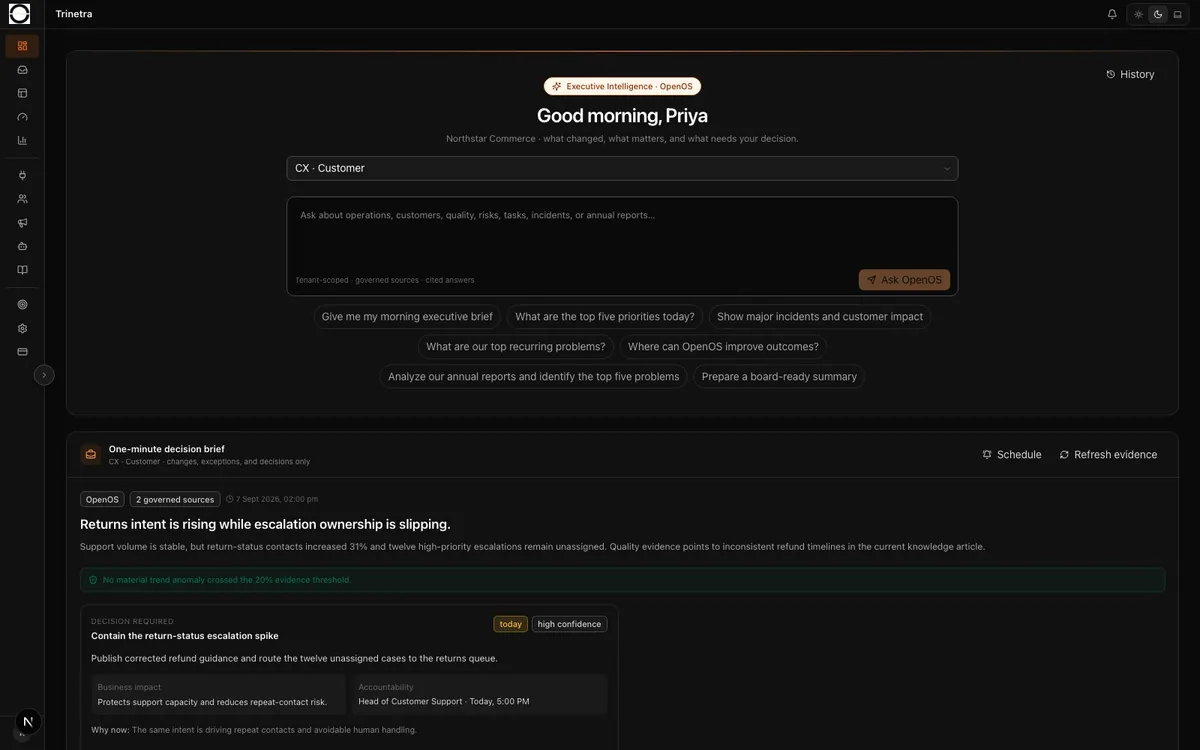 01 Role lens 02 One-minute brief
 Leadership cadence
Leadership needs a current view of material drift, what evidence supports it, which role should own the next move, and whether earlier interventions changed the result.
Containment, repeat contact, queue pressure, customer effort, and escalation ownership.
SLA, staffing pressure, process adherence, quality clusters, and unresolved exceptions.
Workflow reliability, tool failure, provider health, release state, and automation boundaries.
Mechanism
Start with the main material changes, exceptions, and pending decisions.
Open source evidence, assumptions, and confidence rather than accepting a black-box summary.
Choose the recommendation that should become owned operational work.
Return to the affected measure after the intervention window.
Operational control
Role lenses change emphasis without creating separate versions of operational truth.
Tailor the brief to the decisions and evidence relevant to the viewer.
Keep sources and assumptions available for challenge and review.
Separate a proposed owner role in the card from a named assignee in managed work.
Define which measure and time window will be reviewed after action.
One-minute brief
Why are return-status contacts rising while support volume looks stable?
Containment fell and unassigned escalations accumulated for the same intent.
Correct the workflow and route the current unassigned cases.
Track eligible containment, assignment age, and repeat contact after the change.
Measures
Elapsed time from material drift surfacing to selected managed action.
Age of support exceptions and action tasks without a current named assignee.
Change in the explicitly selected measure after the intervention window.
Direct answers
It can display operational measures, but its primary object is the evidence-backed Decision Card and the decision-centered brief around it.
Role lenses can prioritize the questions and evidence relevant to Support/CX, operations, or technology leadership.
Tailored walkthrough
A tailored walkthrough for Support/CX, operations, and technology leaders—using your channels, responsibilities, and success measures.
Prefer email? sales@openost.com