
A message, case state, workflow event, provider event, or quality result.
The OpenOS platform
One evidence model across the support operation.
OpenOS connects the work already happening across customer channels, human exceptions, quality, and provider systems—then frames material drift for a governed decision.
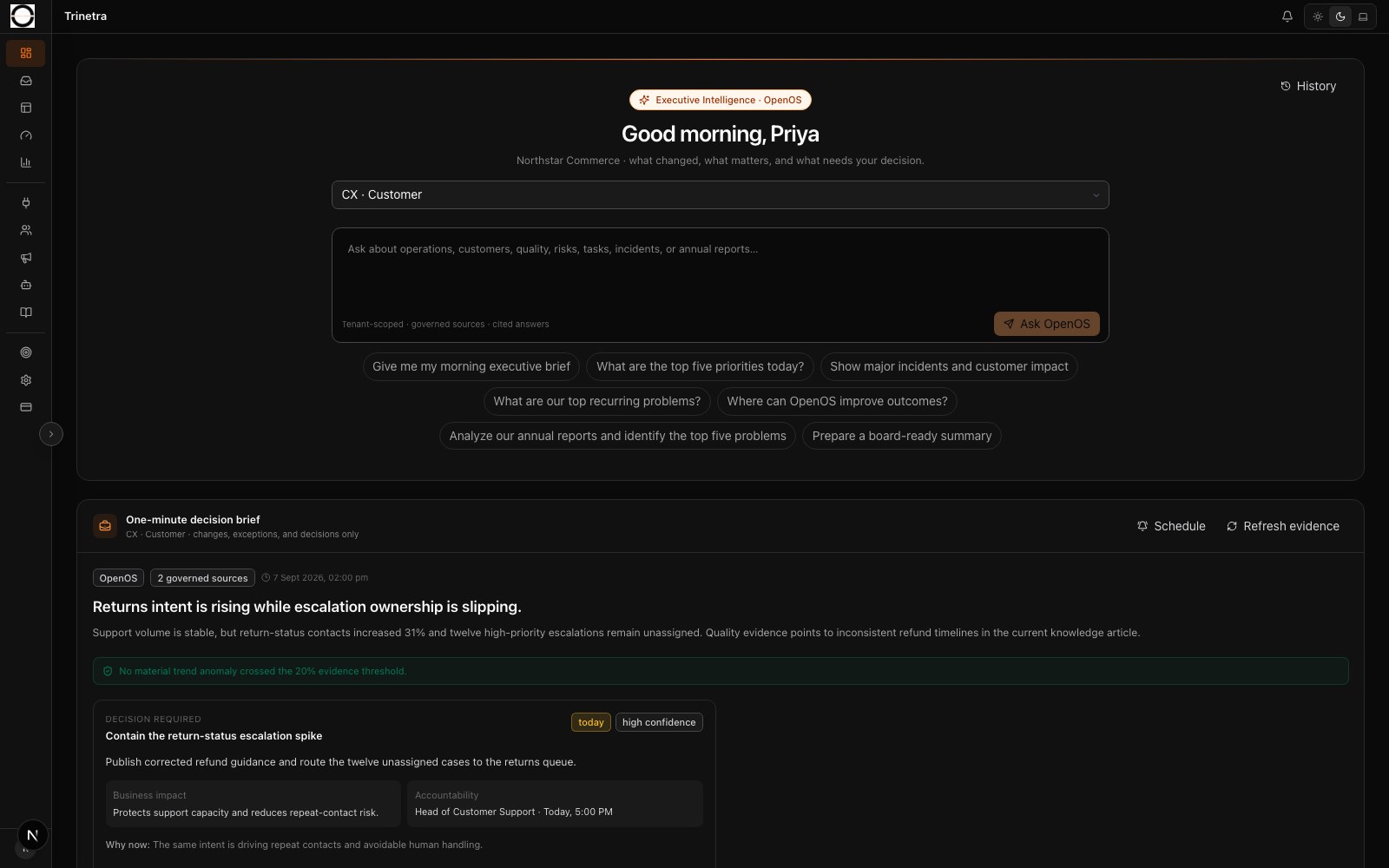 01 Governed sources 02 Decision frame
 The named mechanism
Signal to accountable follow-through.
Each stage adds context without pretending the generated intelligence is already completed operational work.
Normalized tenant-scoped context with source, timing, and operational state.
A material divergence across containment, SLA, assignment, quality, or reliability.
A generated frame with impact, evidence, recommendation, owner role, deadline, and confidence.
A selected recommendation becomes durable work with a named assignee and status.
The agreed operational measure is reviewed after the intervention window.
Shared surfaces
Each product surface sees the same support state.
The loop compounds because the transcript, customer, case, workflow, quality evidence, and operating decision do not reset at every handoff.
01 / Resolve
L0 Agents
Ground first-contact support in approved knowledge, authorized tools, and explicit escalation boundaries.
Explore the surface →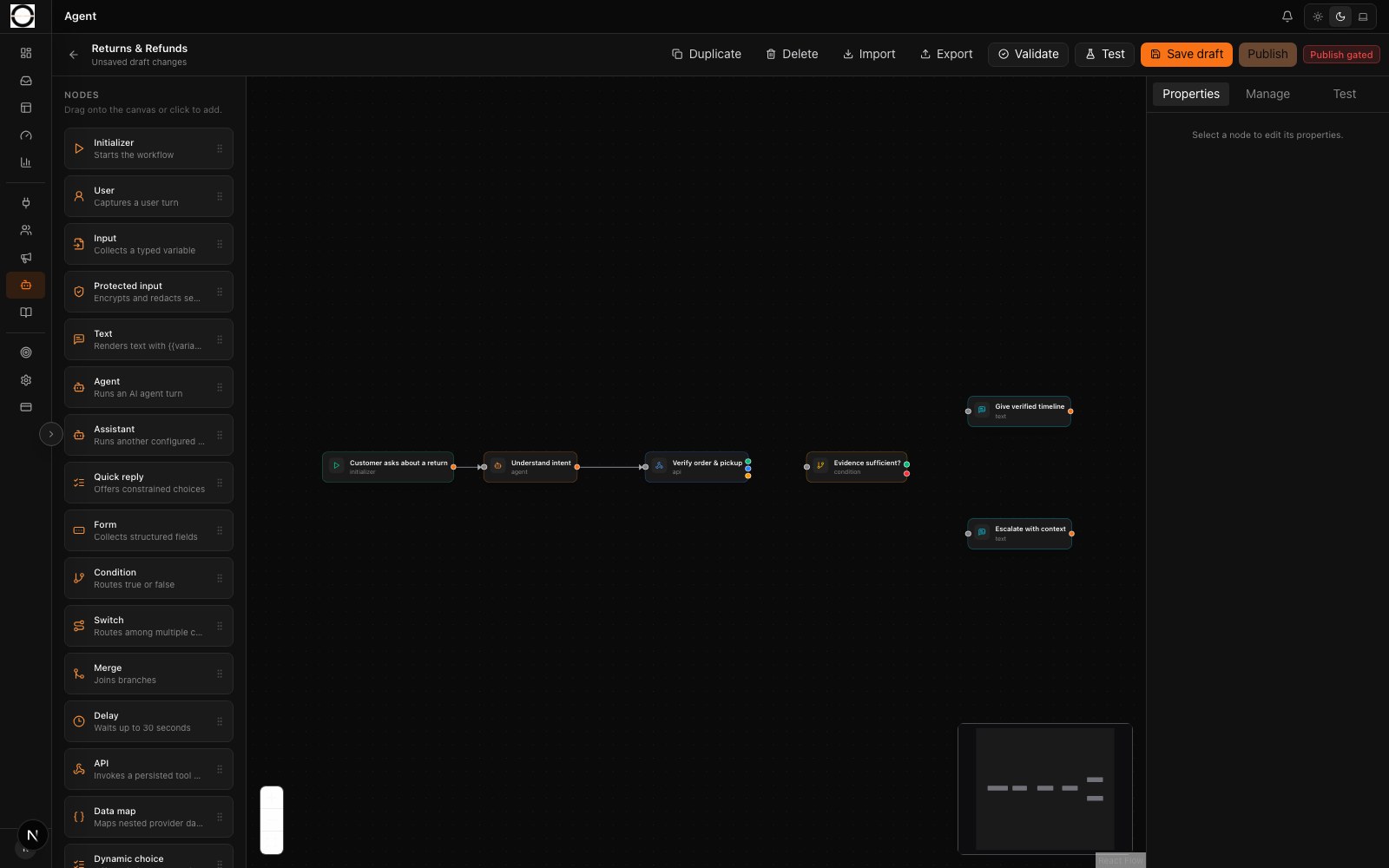
02 / Escalate
Workspace
Give people the transcript, customer context, SLA, and a clear claim path—not a cold ticket.
Explore the surface →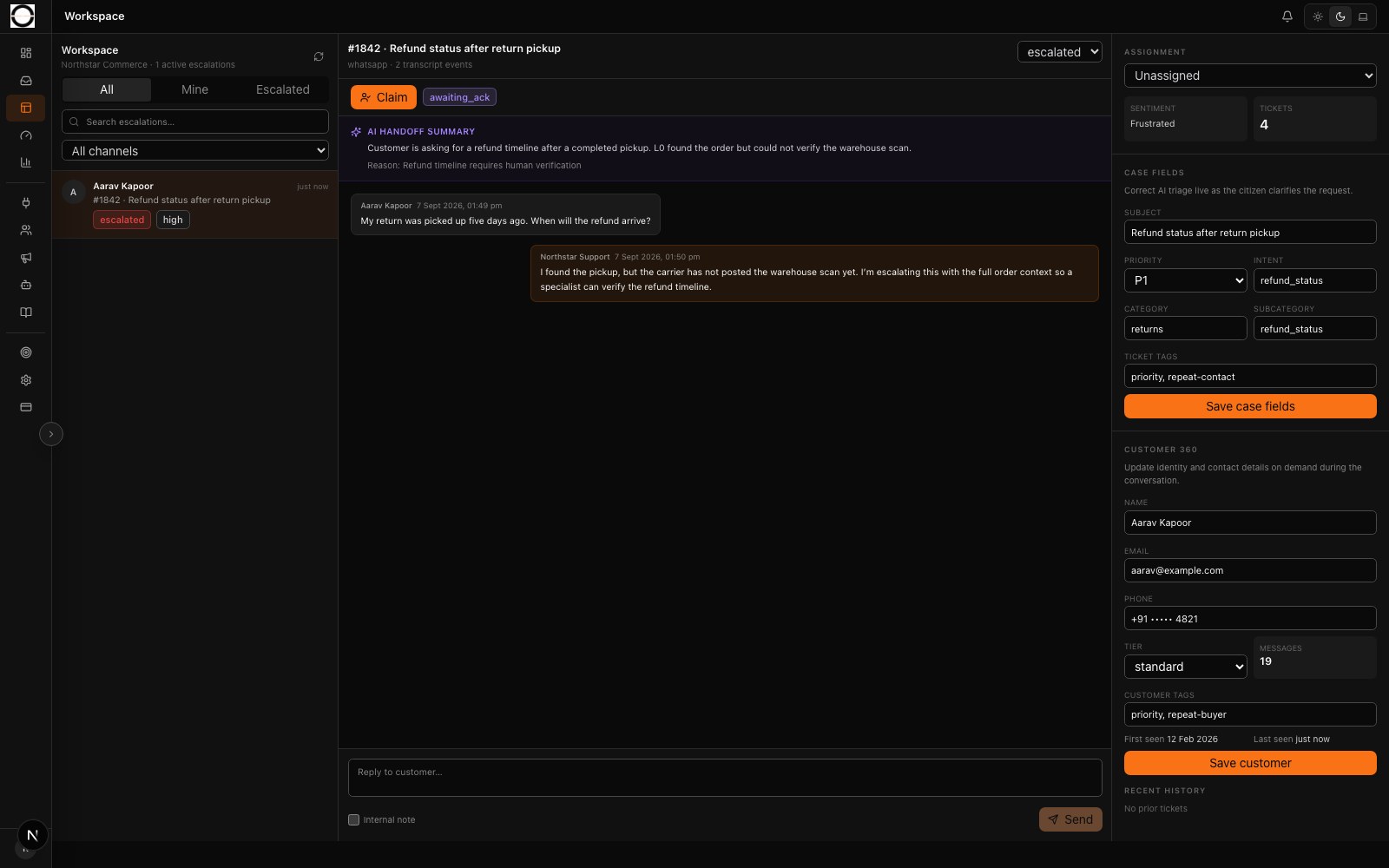
03 / Audit
Quality
Apply versioned scorecards to configured eligible work and preserve the evidence behind every finding.
Explore the surface →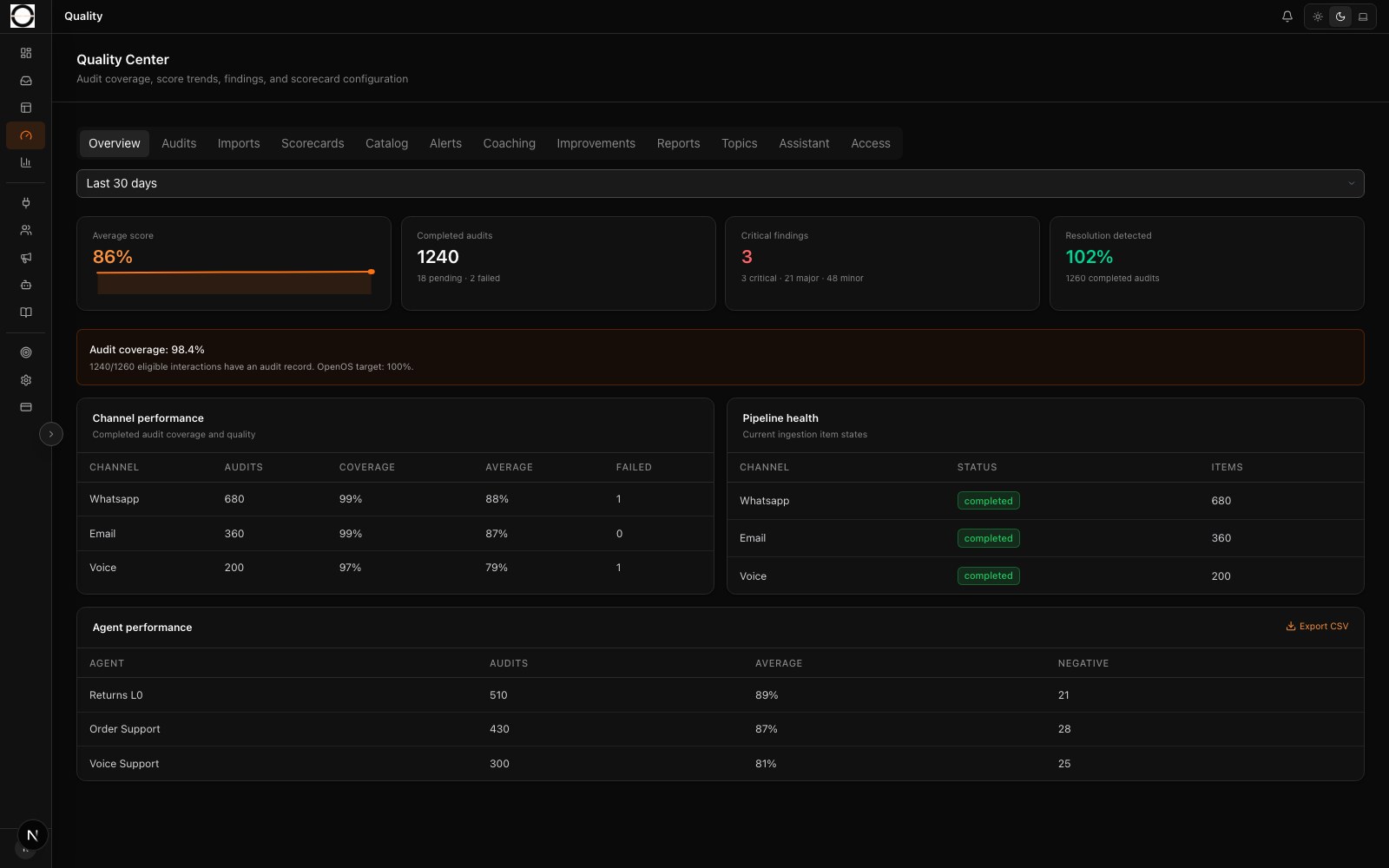
04 / Decide
Trinetra
Correlate repeated support drift into evidence-backed Decision Cards and managed follow-through.
Explore the surface → System boundaries
Above the stack—not in place of it.
OpenOS receives configured signals, maintains a derived support evidence ledger, and executes only through customer-approved provider or tool paths.
- Channel providers own live delivery, media, retries, and concurrency.
- CRM, ERP, helpdesk, and operational systems remain authoritative systems of record.
- OpenOS owns correlation, governance, evidence, exceptions, and Decision Cards.
- Custom connectivity is scoped through provider APIs, webhooks, ingestion contracts, and governed HTTP tools.
WhatsAppVoiceEmailWeb HelpdeskCRMERPCustom APIs
Signals and authorized actions OpenOS
Correlated operational intelligence Support memoryWorkflow evidenceQuality evidenceGovernance
Trinetra Brief → Decision Card → selected managed task → outcome review
The core output
A Decision Card is decision-ready—not magically complete.
The distinction matters. Trinetra generates the structured artifact. A leader evaluates it. A selected recommendation becomes managed work. The affected measure can then be reviewed.
Decision required
High confidence Contain the return-status escalation spike
Twelve unassigned return-status cases are driving repeat contact while L0 containment for the same intent is falling.
Business impactSupport capacity and repeat-contact risk
Proposed owner roleHead of Customer Support
DeadlineWithin 72 hours
RecommendationPublish the corrected workflow and route unassigned cases
Evidence
- Containment declined for return-status intent
- Twelve cases have no current assignee
- Repeat contacts increased in the demonstration window
Governance model
Controls travel with the work.
Governance is expressed in tenant boundaries, roles, release state, tool grants, provider configuration, evidence, and supported approval controls.
Tenant and role scope
Operational records, sources, workflows, and product surfaces remain scoped to the active tenant and authorized role.
Versioned workflow state
Draft, validation, publication, and binding separate authoring from a runtime-approved workflow.
Secret-referenced tools
Credentials stay outside workflow content, while node and revision grants restrict executable actions.
Inspectable provenance
Conversation, provider, quality, and decision context remain available for review rather than disappearing into a generated answer.
Evaluation
Questions technology and operations teams ask.
Does OpenOS replace our helpdesk, CCaaS, ERP, or CRM?
No. OpenOS is designed as the governed support intelligence layer above those systems. The exact read, write, and responsibility boundary is scoped for each connection.
Does Trinetra query every external system live?
No. Trinetra works from tenant-scoped evidence ingested into OpenOS through configured provider adapters, APIs, webhooks, imports, and implementation work.
Where does a first deployment begin?
With one support workflow, its existing channel/provider path, a defined escalation boundary, configured quality criteria, and agreed success measures.
Is every action autonomously executed?
No. Actions are limited to configured tools and supported provider paths. Approval controls apply where implemented, and a recommendation is not represented as execution evidence.
Tailored walkthrough
Map one support workflow onto the platform.
Bring the current channels, systems, escalation path, quality definition, and the measure you want to change.
- 01Your current loopChannels, systems, volume, and the operational gap.
- 02The product proofResolve, escalate, audit, and decide in one scenario.
- 03A scoped first deploymentOne workflow with explicit evidence and success measures.
Prefer email? sales@openost.com