
Hidden denominator
Coverage is measured against the interactions configured, ingested, and eligible for the active scorecard.
Audit / Quality
Direct answer
Quality applies configured, versioned scorecards to eligible ingested interactions. It preserves criterion-level rationale, findings, coverage, and the improvement work that follows.
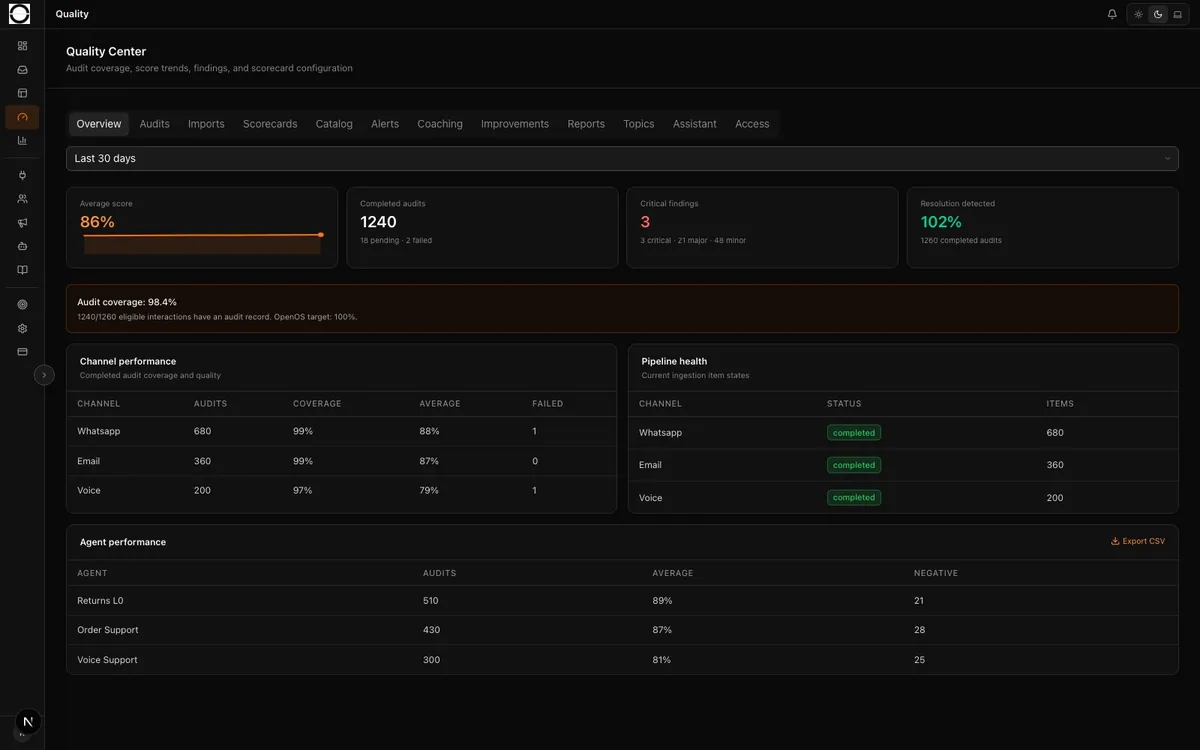 01 Eligible coverage 02 Completed audits 03 Critical findings
 The quality gap
Small samples can miss recurring failures, while universal-coverage claims hide whether every interaction was actually ingested and eligible. OpenOS exposes the configured population and the audit pipeline.
Coverage is measured against the interactions configured, ingested, and eligible for the active scorecard.
Criteria retain rationale, synchronized evidence, severity, and findings for review.
Repeated patterns can move into coaching, alerts, or leadership decision framing.
Mechanism
Configure the scorecard version, criteria, source scope, and eligible population.
Resolved or imported interactions enter the audit pipeline when they meet the eligibility rules.
Store criterion scores, rationale, evidence, findings, severity, and audit state.
Route findings into review, coaching, alerts, and repeated-pattern analysis.
Operational control
The operating model includes the scorecard, evidence, pipeline health, and human review context.
Know which rubric evaluated an interaction and preserve the version used at audit time.
Show completed, pending, failed, and missed work against the configured denominator.
Review criterion-level rationale and the conversation evidence synchronized to the finding.
Identify missed audits and requeue eligible work instead of silently reporting false coverage.
Demonstration scenario
Return-status interactions show repeated process-adherence failures on one queue.
Each finding retains criterion rationale and conversation context.
The Quality owner creates coaching and raises the repeated operational pattern.
Trinetra can frame the broader workflow issue when the pattern becomes material.
Measures
Completed audits divided by the configured eligible interaction population.
Audits with a finding at or above the configured critical severity.
Eligible interactions that have not reached a completed audit state.
Direct answers
Yes. Scorecards and criteria are configured for the entitled tenant scope and preserved by version.
Controlled imports and Quality ingestion contracts support selected chat, email, and audio sources in supported formats.
No. It means coverage of the population that was configured, ingested, and eligible for the applicable scorecard.
Tailored walkthrough
A tailored walkthrough for Support/CX, operations, and technology leaders—using your channels, responsibilities, and success measures.
Prefer email? sales@openost.com